
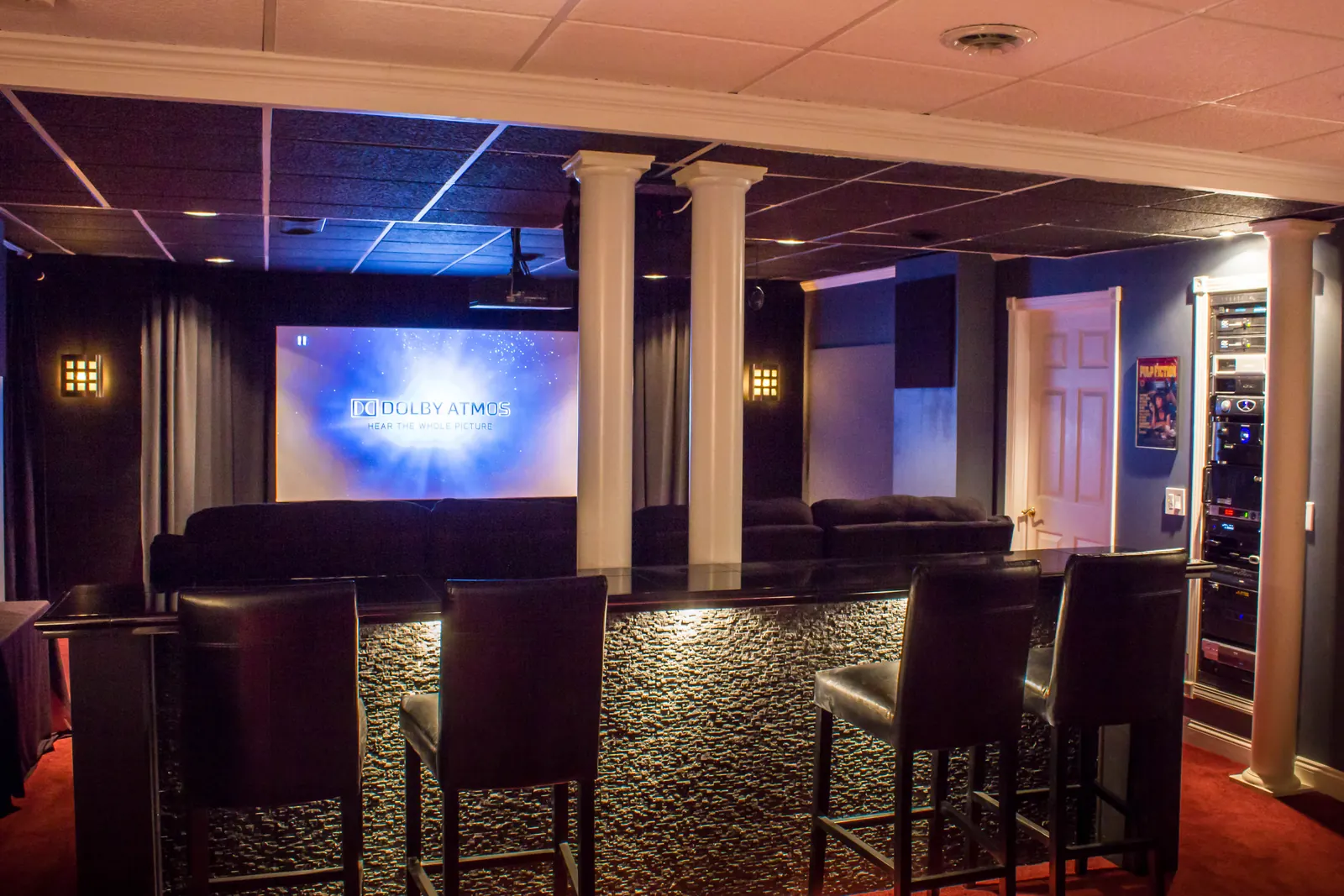
Design the room and image together
Choose seats and sightlines before screen size. Account for viewing distance, projector throw or television dimensions, risers, door swings and ambient light. A bright showroom image does not predict performance in your room; compare display type, screen material and light control as a package.
Decode the speaker layout
Dolby notation identifies listener-level speakers, subwoofers and height channels: 5.1.2 means five ear-level speakers, one low-frequency channel and two overhead or Atmos-enabled channels; 7.1.4 adds rear surrounds and four height channels. Follow Dolby placement angles rather than arranging speakers only where construction is convenient.
Treat the room, especially bass
Reflections and room modes can dominate what you hear. Soft finishes, purpose-designed absorption and diffusion, sealed doors and quiet HVAC can improve clarity. Multiple subwoofers may produce more even bass across several seats when placed and calibrated correctly; more output alone is not the goal.
Plan signal, power and ventilation
A current 4K UHD and Dolby Atmos design typically requires an AV receiver with HDMI 2.1 or later. Verify source, cable length, HDR, refresh rate and eARC requirements end to end. Provide surge protection, rack cooling, service access and spare conduit for future cable standards.
Commission the complete experience
Calibrate levels, delays, crossover, equalization and image settings after furniture and finishes are installed. Program one clear Watch action, lighting scenes and a simple shutdown. Keep an equipment list, wiring schedule and backup of control programming so the room remains supportable.
How we apply this
At Skynet Domotics, we integrate audio and video with the home's network, lighting, control platform, and architecture. Our scope can include design, wiring, equipment selection, installation, programming, calibration, and owner training for a simple, consistent experience.
Explore the related service or request an assessment for your home.
Home theater design · Request a consultation
Image credit: Christian Collins — CC BY 2.0